
Termites · Broward County, FL
Termite Swarm Season in South Florida: A Month-by-Month Guide by Species
The short answer
South Florida swarms earlier than the rest of the state. UF/IFAS has recorded activity in the Fort Lauderdale area from the last week of February, while most of Florida does not begin until mid-April. Different species swarm at different times of year and different times of day.
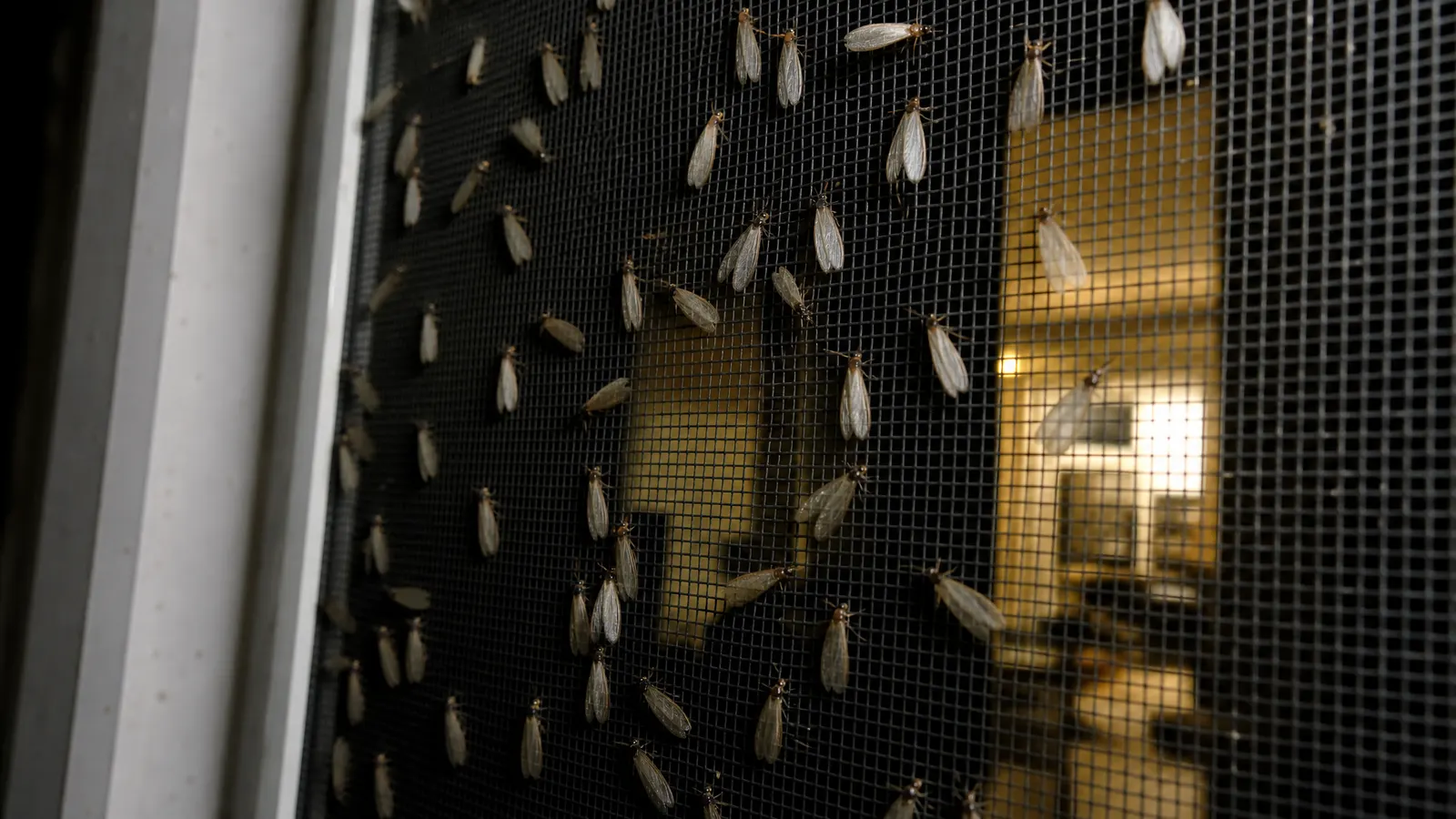
A swarm is loud, brief, and gone before most people think to write anything down. Several hundred winged insects pour out of a soffit at dusk, circle the porch light for twenty minutes, and by morning all that is left is a scatter of wings on the windowsill. The date and the hour are real diagnostic information — in Broward they narrow the species before anyone looks at a board.
When termites swarm in Broward
A swarm is a colony reproducing. A mature colony releases alates — winged reproductives — in one synchronized flight. They pair off, shed their wings, and the few survivors try to start colonies of their own. For those twenty minutes, an insect that spends its whole life inside wood or below a slab is out where you can see it.
Florida makes that event more complicated than anywhere else in the country. UF/IFAS documents 20 established termite species in the state — six of them invasive, and the highest termite diversity of any state in the mainland US. Several are structural pests, several arrived through South Florida ports, and the two most destructive subterranean species are both established here.
Then the calendar. Advice written for the rest of the country puts termite season in mid-spring, and here that is roughly two months late. UF/IFAS has observed activity in the Fort Lauderdale area from the last week of February, while most of Florida does not begin until mid-April to early May. By the time a national article tells you to start watching, Broward's first flights are already over.
Thomas Chouvenc of UF/IFAS puts the working window plainly: "From March to June, termite activity is the most visible, which means it is a good time to pay attention and have a termite checkup."
Visible is the operative word. Most of the year the evidence has to be hunted: the attic, the slab edge, under the deck. From March through June it comes to you instead.
Swarm calendar by species
Species fly at different times of year and different times of day, and time of day is the part most people throw away. A dusk flight in early March and a flight late on an April evening are probably two different insects — the date does most of the work, and the hour narrows what is left.
| Species | When it swarms | Time of day | Where it is found |
|---|---|---|---|
| Asian subterranean (Coptotermes gestroi) | From early March | Dusk | Tropical; distribution largely restricted to South Florida |
| Formosan subterranean (Coptotermes formosanus) | Early April to late June, peaking in May | Shortly after sunset, flying toward lights | Established here; builds carton nests in walls, attics and trees |
| West Indian drywood (Cryptotermes brevis) | Late spring and the summer months are the peak season for winged flights | Often the evening | A major structural pest of coastal and southern Florida |
| Eastern subterranean (Reticulitermes spp.) | Not documented locally as tightly as the three above | — | Statewide, Broward included |
The drywood row uses the FDACS phrasing rather than a month range on purpose: you will see tighter ranges published elsewhere, and they are worth less than they look. The Eastern subterranean is listed because it is present statewide, not because it drives the flights people notice here — those are dominated by the two Coptotermes species and the West Indian drywood.
The practical use: if you can give the date, the approximate hour, and whether the insects came off the ground, a tree or the roofline, you have narrowed the field before an inspection starts.
Termite swarmer or flying ant?
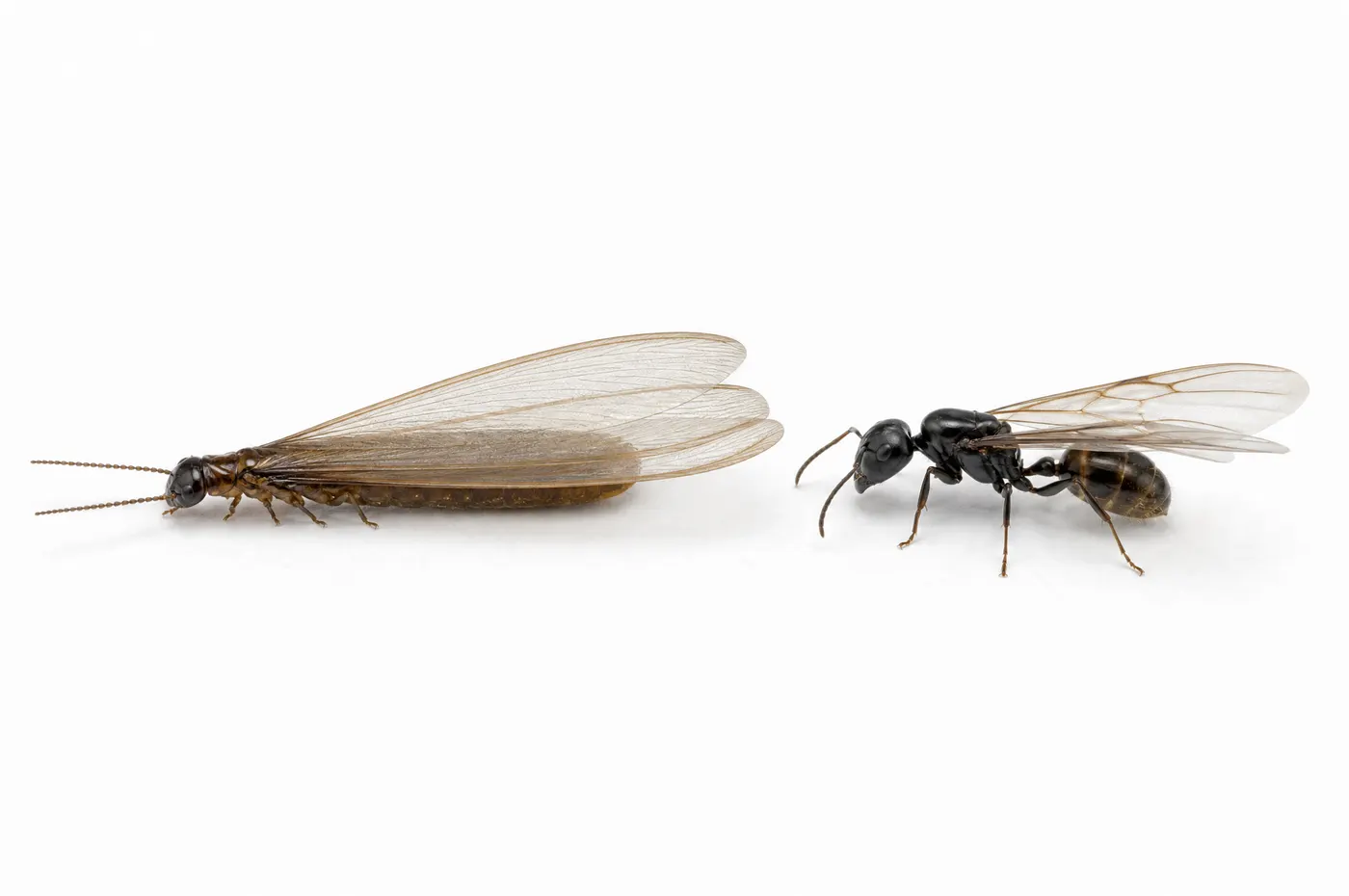
Ants swarm in spring too, fly to the same porch lights, and shed their wings on the same sills. FDACS gives three tells, and they hold up in a kitchen with a phone camera.
| Termite swarmer | Flying ant | |
|---|---|---|
| Waist | Thick and straight — the body reads as one unbroken tube | Pinched sharply, like a wasp |
| Antennae | Straight, with no bend | Elbowed, with an obvious bend partway along |
| Wings | Four, all roughly equal in length | Hind pair noticeably shorter than the front pair |
In practice the wings are the tell you get to use, because wings are what gets left behind. Four loose wings of the same length is a termite. A mismatched set — one pair clearly longer than the other — is an ant. The waist is faster when you have the whole insect: a termite is a tube, head to abdomen, no pinch anywhere.
None of this makes an ant swarm good news. It makes it a different problem with a different fix, and it means the flight you photographed may have nothing to do with wood.
Drywood or subterranean?
This is the split that decides everything downstream. The two live different lives, leave different evidence, and the approaches that exist for one do nothing for the other. Broward has both.
Drywood: no mud, and galleries that ignore the grain
Drywood termites live inside the wood itself, with no contact with soil. Needing no connection to the ground is why they turn up in attic framing, fascia, window frames, door jambs and furniture.
The detail almost nobody publishes is what the galleries look like. Per FDACS, drywood galleries cut across the wood grain and destroy both the soft spring wood and the harder summer growth. UF/IFAS adds the part that settles it in the field: because a drywood colony has no connection to the ground, its galleries contain no mud. The insect eats the board without regard for how the board is built.
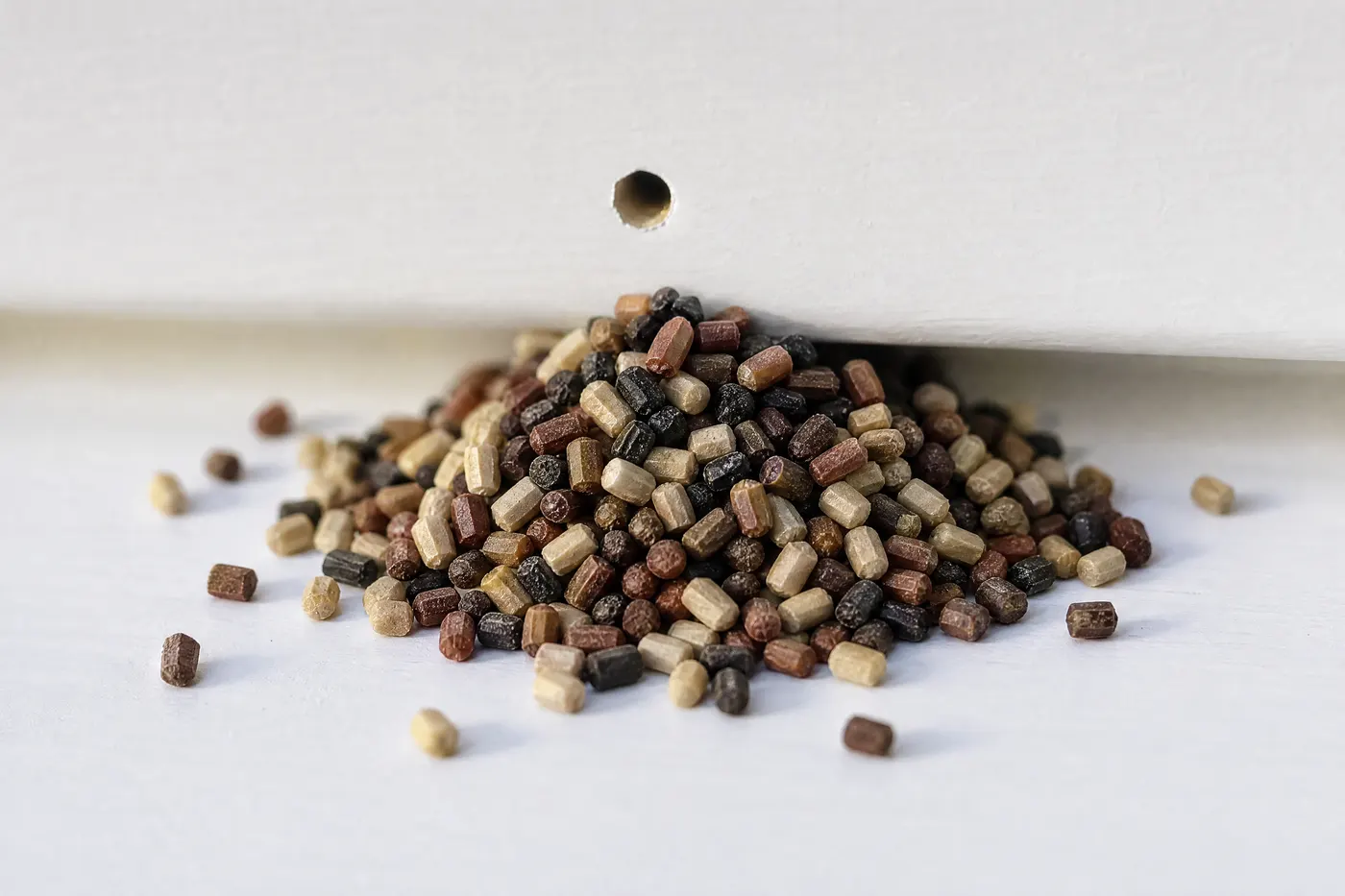
Then there is frass. Drywood termites push hard pellets out through kick-out holes, and the pellets pile up below whatever is infested — a windowsill, the top of a baseboard, the floor under a door frame. They run cream to reddish-brown or black, and FDACS is explicit that "the color of the pellets is not related to the color of the wood." People talk themselves out of a real finding because the pellets look too dark for the trim. That reasoning does not hold.
Blistering or bubbling on the surface of painted wood can mean galleries have reached the surface, which puts an infestation well past its early stage. It can also just mean a leak — but it is worth opening up either way.
Subterranean: soil in the galleries, and tubes to reach the wood
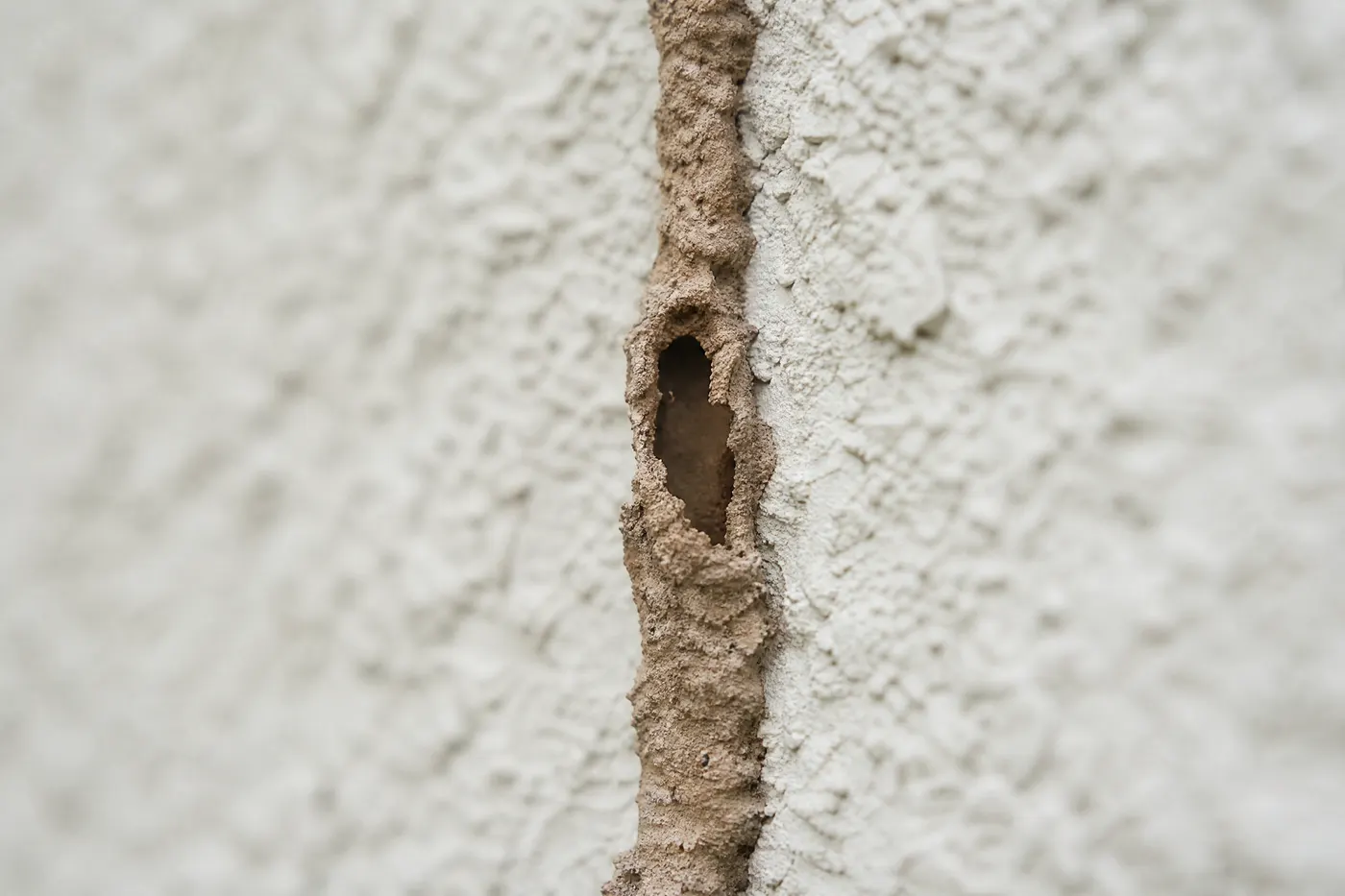
Subterranean termites live in the soil and have to maintain contact with it. To reach wood above ground they build mud shelter tubes — earthen tunnels about the width of a pencil, running up foundation walls, piers and slab edges.
Their galleries follow the grain, take the soft spring wood first, and are packed with soil. That is the fastest field distinction there is: mud in the wood means subterranean, and drywood never leaves mud.
The Formosan adds a complication. It builds carton nests — chewed wood and soil cemented together — inside wall voids, attics and trees, which lets part of the colony hold its own moisture above ground.
What a past treatment does not tell you
Worth being blunt about, because it gets sold badly. Fumigation leaves no residual protection in the structure. It addresses what is in the building at the time and nothing after, so a fumigated house can be re-infested by the next swarm that finds it. "We tented in 2019" is a fact about 2019.
Swarmers indoors don't always mean an infestation
This part of the subject carries the most commercial pressure, so here is UF/IFAS verbatim: "If winged termites are found in a house, this does not mean that there is an actual infestation. Termites may have flown from the outside after being attracted by the light inside your home."
Swarmers are weak fliers pulled hard toward light. A Formosan flight that starts in a neighbor's tree at nine at night ends up wherever the light is. Twenty of them on the kitchen floor tells you a mature colony flew within range that night. Range is the neighborhood, not necessarily the house.
That is not a reason to ignore it. It is a reason not to buy a treatment on the strength of it alone — a prompt to look, not a diagnosis.
The wings are the better evidence
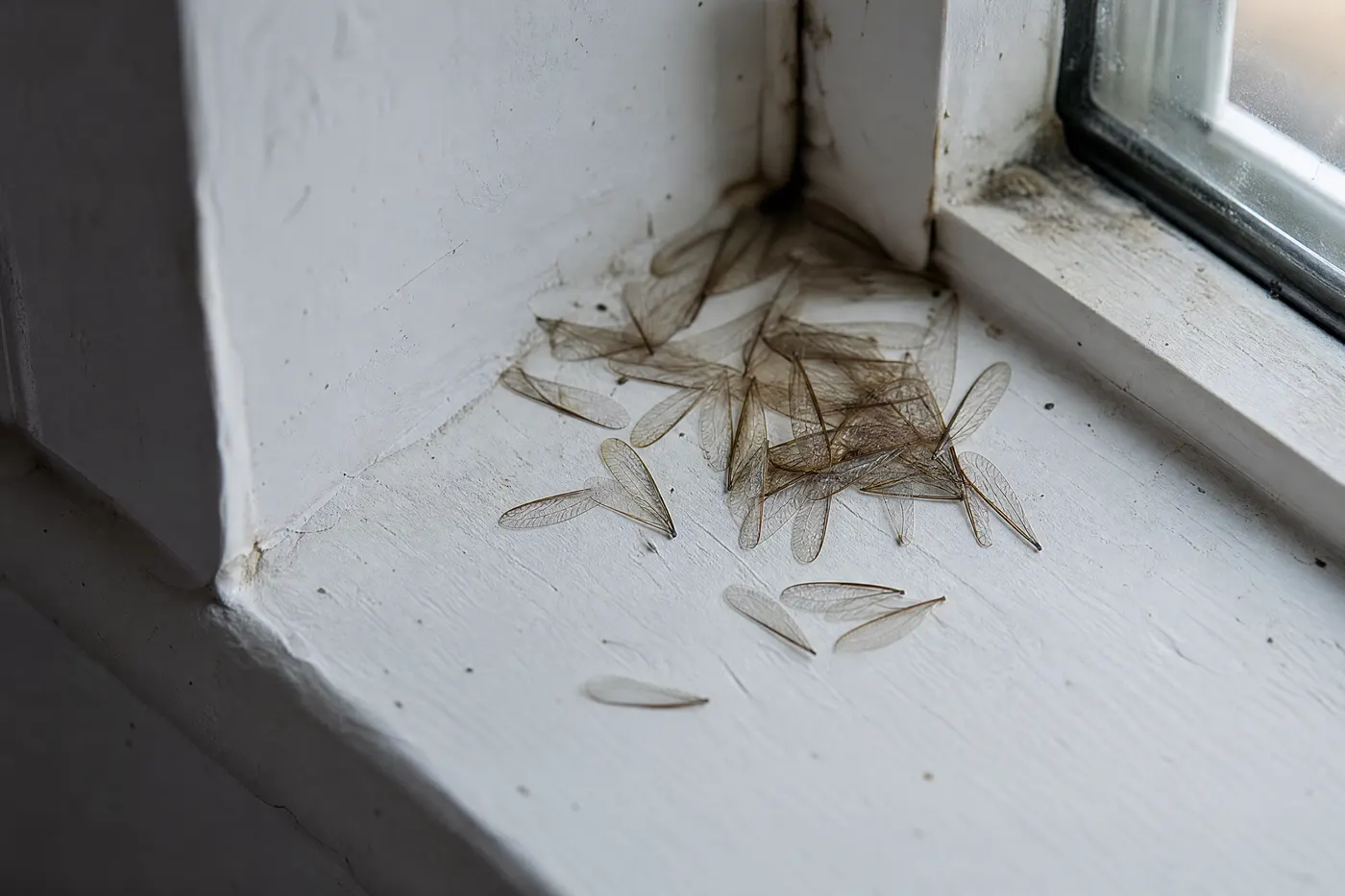
Swarmers shed their wings shortly after flight, which makes discarded wings more informative than the insects themselves. A pile of them says the flight ended here rather than passed through.
Where you find them matters more than how many: interior windowsills, the bottom of a tub or sink, a spiderweb in the corner of the garage, the track of a sliding door. Wings collecting in a room that was shut is worth having looked at.
The reverse is true as well. Never seeing a swarm proves nothing either way — colonies work inside wood and below slabs for years, and the flight lands on a handful of evenings you may not be home for.
What to do if you see a swarm
- Collect a few before you sweep. Tape two or three to an index card, or drop them in a container; rubbing alcohol keeps them intact. A specimen settles the termite-or-ant question in seconds. A blurry photo of a bug on a white floor does not.
- Write down the date and the hour. Dusk or full dark. Indoors or out. Which room, which side of the house, whether the lights were on. Set against the calendar above, that is most of an identification.
- Look for wings, not just insects. Sills, tubs, sinks, spiderwebs, door tracks. This is the evidence that outlasts the flight by weeks.
- Walk the perimeter in daylight. Mud tubes on the foundation, piers and slab edge. Pellet piles under wood. Blistered paint. Boards that sound hollow when you tap them.
- Don't spray the swarm. The alates on the windowsill are the part of the colony that already failed. Killing them changes nothing about the colony that produced them, and it destroys the specimen you needed to identify it.
- You can have the species identified at no cost. UF/IFAS runs a termite identification service out of its Fort Lauderdale Research and Education Center — you submit a sample and get the species back. It is a public research resource with nothing to sell.
The species and how far it has spread determine what a house needs, and neither can be settled from a windowsill. What a swarm hands you is a date, an hour and a specimen — the most the inside of your walls will volunteer all year, sitting on the floor for about one morning.
Frequently asked questions
Earlier than the rest of the state. UF/IFAS has recorded activity in the Fort Lauderdale area from the last week of February, while most of Florida starts mid-April. Activity is most visible from March through June.
Three things. Termites have a straight, thick waist; ants are pinched like a wasp. Termite antennae are straight; ant antennae are elbowed. Termite wings are four of roughly equal length; an ant's hind wings are noticeably shorter.
Swarmers shed their wings shortly after flying, so a pile of discarded wings on a sill or in a spiderweb is stronger evidence than the insects themselves. It is worth an inspection to find out whether they came from inside the structure.
Not on its own. Swarmers are drawn to light and regularly fly in from outside. UF/IFAS makes this point explicitly. What confirms an infestation is physical evidence in the structure — frass, mud tubes, damaged wood or discarded wings.
Formosan subterranean termites swarm at night toward lights, typically late April into May. Asian subterranean termites swarm at dusk starting around March. Time of day is part of how a technician narrows down the species.
Still dealing with it?
Termite Control across Broward County, FL.
Book online in a few minutes and a Broward tech calls you back with your exact price (Mon–Fri 9am–5pm) — before any work starts.
Book a termite inspectionKeep reading
Hybrid Termites Confirmed in Broward County: What It Actually Means for Your Home
UF/IFAS confirmed hybrid Coptotermes colonies in Broward. The honest version: they're rare, the damage is comparable, and the treatment doesn't change.
What Florida Law Requires Your Termite Contract to Say
Page one has to name which termite you're covered for, and any excluded invasive species has to be named too. What to read before you sign.